Office sound masking systems
We design, install and calibrate sound masking that stops conversations carrying across open-plan floors, meeting rooms and reception areas. Typically £18 to £32 per m² installed, fitted out of hours across the UK.
- Biamp Cambridge QtPro and Soft dB Logison
- Installed over working nights
- Calibrated zone by zone
- ISO 27001, 9001 and 14001
QUICK REFERENCE
Strive AV designs, installs and commissions sound masking for UK offices, law firms, banks, healthcare and education: networked Biamp Cambridge QtPro and Logison AC-S systems, calibrated zone by zone with a sound level meter. Typically £18 to £32 per square metre installed. ISO 27001, 9001 and 14001 certified.
Sound masking costs in the UK
| What you need | Typical installed cost |
|---|---|
| Single private office or meeting room | £500 to £2,000 |
| 500 m2 open-plan floor | £14,000 to £16,000 |
| 1,000 m2 floor (two to four zones) | £20,000 to £30,000 |
| 2,000 m2 floor or two floors | £36,000 to £48,000 |
| Commissioning and tuning (included above) | £1,000 to £2,500 per floor |
Indicative installed prices including design, emitters, controller, cabling and calibration. Exposed-soffit ceilings sit at the top of the per-m2 band. Full sound masking cost breakdown.
AT A GLANCE
- Typical cost
- £18 to £32 per m2 installed
- 1,000 m2 office floor
- £20k to £30k, 2 to 4 working nights
- Masking level
- 42 to 48 dBA, tuned to the speech spectrum
- Certifications
- ISO 27001 · 9001 · 14001
WHERE WE WORK
Sound masking across the UK
Designed and project-managed from our East Grinstead head office and installed by our own engineers and vetted local partner engineers.
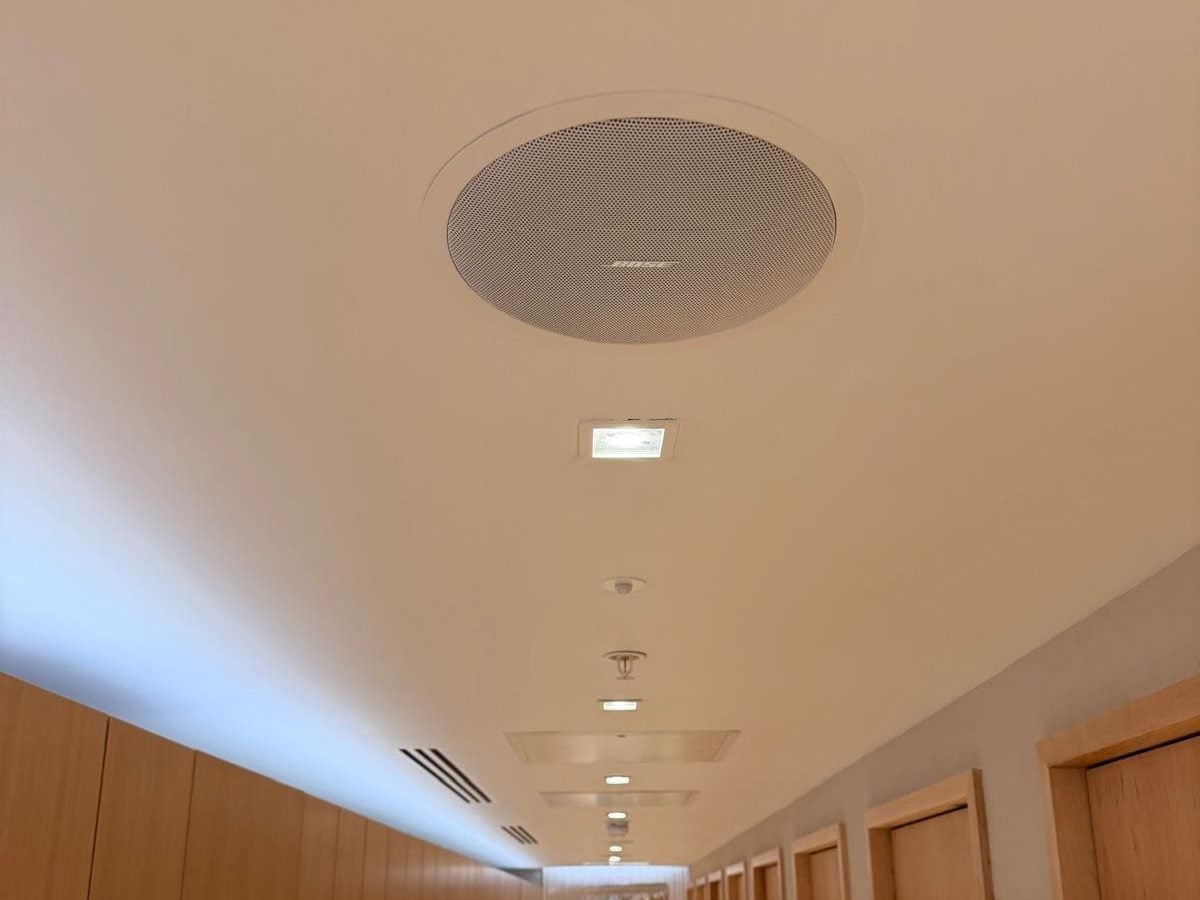
Sound masking vs white noise, acoustic panels and soundproofing
They solve different problems, which is why the wrong one often gets bought first. Many offices end up with panels for echo and masking for privacy.
| Option | What it does | Best for | Will not fix | Typical cost |
|---|---|---|---|---|
| Sound masking | Adds a quiet, speech-shaped background sound from ceiling emitters | Overheard conversation and distraction in open-plan areas | Echo, or noise coming through walls | £18 to £32 per m² |
| White noise machine | Plays flat, equal-energy noise from a single unit | Very small rooms, temporarily | Even coverage across a floor; most people find it irritating | £50 to £300 per unit |
| Acoustic panels | Absorb sound on walls and ceilings | Echo and reverberation, harsh-sounding rooms | Speech privacy between desks (quiet rooms can feel less private) | £40 to £150 per panel |
| Soundproofing | Adds mass and seals to walls, floors and doors | Sound travelling between rooms | Distraction within the same open-plan space | Building works; varies widely |
Quick reference: masking for overheard speech, panels for echo, soundproofing for noise between rooms. More on sound masking vs acoustic panels.
Where offices use sound masking
Open-plan floors
Cuts the radius at which a conversation is understood, so teams can sit closer without constant distraction.
Meeting rooms and private offices
Stops speech leaking through partitions and glazing, which is cheaper than rebuilding walls to a higher acoustic rating.
HR, partner and client suites
Protects confidential conversations in law firms, banks and professional services. See our work for legal firms and financial services.
Reception and waiting areas
Keeps phone calls and visitor conversations at the desk from carrying into the waiting area.
Healthcare consulting areas
Supports UK GDPR patient confidentiality at receptions, nursing stations and consulting rooms.
Refurbishments and new builds
Designed in with the ceiling and M&E contractors, or retrofitted above an existing grid with no desk moves.
Sector pages: AV for law firms and AV for financial services.
How a sound masking project runs
- 1
Floor-plan review or survey
We check the ceiling type, plenum depth, HVAC noise and how each area is used, then agree the speech privacy targets.
- 2
Zone design
Emitter layout and zoning drawn up per floor, with separate zones for open-plan, meeting rooms, reception and private offices.
- 3
Out-of-hours install
Emitters and cabling go in above the grid over a few working nights, so the office keeps running.
- 4
Calibration
Every zone tuned with a 1/3-octave analyser to the design spectrum, typically 42 to 48 dBA.
- 5
Handover and support
Commissioning report with measured levels per zone, staff briefing and an annual level check.
Quick reference: survey, zone design, 2 to 4 working nights to install a 1,000 m² floor, calibration, commissioning report.
Sound masking FAQs
Q.How much does a sound masking system cost in the UK?
Sound masking is priced per square metre of treated ceiling. A networked system such as Biamp Cambridge QtPro or Soft dB Logison typically costs £18 to £32 per m² fully installed, with small deployments at the top of the band and full-floor rollouts at the bottom. A 1,000 m² office floor usually lands at £20,000 to £30,000 including design, calibration and commissioning. We give a fixed price after a floor-plan review or a short site visit. See the full sound masking cost breakdown.
Q.Which sound masking systems do you install?
We are vendor-agnostic. The platforms we design around most often are Cambridge Sound Management QtPro and QtX (now part of Biamp), Soft dB Logison and AtlasIED. The right one depends on the ceiling (accessible tile grid, exposed soffit or a mix), how many zones you need and whether the system should share a network and control platform with your other AV.
Q.How is sound masking different from white noise?
White noise has equal energy at every frequency, so it sounds hissy and most people find it irritating. Sound masking is shaped to the frequency range of human speech (roughly 100 Hz to 5 kHz) and set at 42 to 48 dBA, so it covers conversation without drawing attention to itself and blends in with air-conditioning noise. More detail in sound masking vs white noise.
Q.Is sound masking worth it for an office?
It is worth it where overheard conversation is the problem: open-plan floors, rooms next to HR, partner or client suites, and reception desks. The improvement can be measured rather than guessed: we take speech privacy readings before and after, and the system is tuned zone by zone until the target is met. Emitters have no moving parts and need only an annual level check. If the problem is echo rather than overheard speech, acoustic panels are the better first spend.
Q.How long does sound masking installation take and is it disruptive?
A 1,000 to 1,500 m² floor is typically installed in two to four working nights, so the business day is not disrupted. Work happens above the ceiling grid, so desks and IT stay where they are. Calibration is done out of hours with a sound level meter and a 1/3-octave analyser to confirm each zone matches the design spectrum. Exposed-soffit floors can need access equipment and weekend working. Larger buildings are phased floor by floor.
Q.Will sound masking help with WELL, BCO and BREEAM targets?
It can. WELL v2 feature S06 (Minimum Background Sound) specifically recognises sound masking in open-plan and enclosed spaces, BREEAM Hea 05 covers acoustic performance, and the BCO Guide to Specification sets acoustic expectations for office floors. We provide commissioning reports with measured levels per zone, which your acoustician or sustainability consultant can use in their submission.
Q.Is sound masking suitable for legal, finance and healthcare spaces?
Yes; it is most valuable wherever confidential conversations happen. Law firms and banks use it around partner suites, deal rooms and HR offices; healthcare providers use it at reception, nursing stations and consulting rooms to support UK GDPR patient confidentiality. We design to a measured speech privacy target (for example an Articulation Index below 0.20 in adjacent zones) rather than a fixed volume.
Q.What maintenance does a sound masking system need?
Very little. Networked systems have no moving parts, run on low-voltage cabling and report faults to the controller. We recommend an annual visit to re-check levels with a calibrated meter, rebalance zones after any office reconfiguration and update controller firmware. Remote monitoring is available so an emitter fault is picked up before anyone notices.
Trusted AV Partner to Leading Organisations












Further reading on sound masking
- What is a sound masking system?
- Sound masking vs acoustic panels
- Sound masking vs white noise
- How much does sound masking cost in the UK?
- Portable sound masking devices vs installed systems
- How to troubleshoot sound masking system issues
Working in a school or university? See the sound masking for education guide.
SOUND MASKING QUOTE
Get a price for your floor
Send the floor area, ceiling type and the areas you want treated. A floor plan helps. We will come back with a per-m² price range, then a fixed price after a short survey.
- Reply within one working day
- Fixed price after a floor-plan review or survey
- Installed out of hours, no desk moves
- Or call us: +44 1423 226 638