Pillar Guide
Digital Signage: The Complete UK Guide for 2026
A complete UK guide to digital signage in 2026: solutions, software, costs, and use cases across retail, hospitality, healthcare and more.
Read complete guideStrive AV is a UK digital signage company: we design signage networks, supply commercial screens and players, set up a CMS your team will actually use, produce content and keep every screen running under a managed support contract, from a single reception screen to a multi-site estate.
Jump to: what digital signage is · our services · ballpark your project · digital signage installation · best digital signage software compared
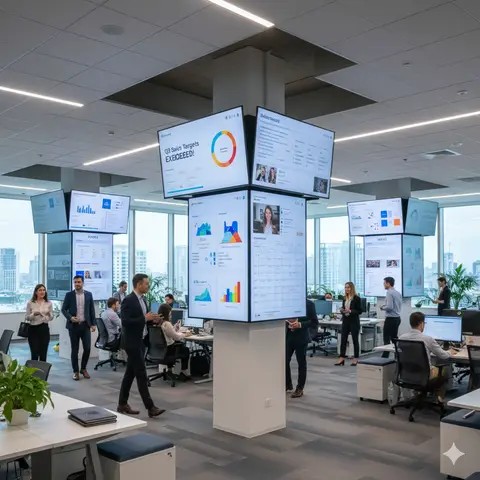
Digital signage is a network of commercial-grade screens showing content that is scheduled, updated and monitored remotely from a content management system (CMS). Organisations use it for reception and wayfinding screens, internal communications, menu boards, retail promotions and live data dashboards.
Unlike a TV with a USB stick, a signage network is built to run 16 to 24 hours a day, and one person can change what every screen shows from a browser. Here is why commercial displays matter.
| Component | What it does | Typical options |
|---|---|---|
| Commercial display | Shows the content, rated for 16/7 or 24/7 use | Samsung, LG, Sharp/NEC, Philips; direct-view LED for large seamless video walls |
| Media player | Stores and plays the content on each screen | Built-in System on Chip, BrightSign, small-form-factor PC |
| CMS software | Schedules, updates and monitors every screen remotely | ScreenCloud, Yodeck, Samsung MagicInfo, BrightSign |
| Network | Delivers content and health alerts | Wired ethernet or managed Wi-Fi on a dedicated VLAN; 4G/5G backup |
| Content | What people actually see | Branded templates, live data feeds, scheduled campaigns |
Quick reference: commercial displays + media player (or built-in SoC) + cloud CMS + managed network, run centrally and rated for 16/7 or 24/7 operation.
Six services cover a signage network from first sketch to year five. Take all of them as one project, or just the parts your team cannot do in-house.
Site survey, screen positions, sight lines, brightness, network and CMS selection, written up as a fixed-price design before anything is ordered.
AV consultation and designCommercial displays from Samsung, LG, Sharp/NEC and Philips, BrightSign and System-on-Chip players, mounts and enclosures, bought at trade volume and bench-tested before despatch.
AV equipment supplyMounting, cabling, player enrolment and commissioning by our own and partner engineers, with labour from £150 to £600 per screen and multi-site rollouts delivered in regional waves.
Digital signage installers across the UKScreenCloud, Samsung MagicInfo, Yodeck, BrightSign or LG SuperSign configured with your users, roles and schedules, then handed over with training your marketing team can act on.
Digital signage software and CMSBranded templates, motion graphics and live data feeds, launched as a 6 to 10 template pack and kept fresh on a monthly retainer of £200 to £800 per network.
Ask about content packagesRemote monitoring with screen-on confirmation, CMS licence renewals, warranty handling and on-site response under a written SLA, priced per screen per month.
Managed digital signage and supportAs a digital signage supplier we hold trade accounts with the display and player manufacturers UK integrators specify most, so a quote covers the hardware, the mount, the player and the licence on one order rather than four. Everything is commercial grade; we do not supply consumer TVs for signage duty.
| Category | Brands and ranges we supply | Typical trade price |
|---|---|---|
| Indoor commercial displays | Samsung QM and QH, LG UH7 and UM3, Sharp/NEC M and ME series, Philips Q-Line, 32 to 98 inch | £400 to £2,500 |
| High-bright and outdoor | Samsung OH and OM window series, LG high-bright, IP-rated enclosures | £2,500 to £12,000 |
| Media players | Built-in System on Chip (Tizen, webOS), BrightSign XD and XT, small-form-factor PCs | £0 to £400 |
| LED and video walls | Direct-view LED cabinets and thin-bezel LCD tiles with processors, for video walls | £6,000 to £100,000+ |
| Ready-made kits | TopAV screen-plus-player kits for single sites, priced live in the cost section below | From £500 |
Supply-only orders are welcome. Procurement, lead times and framework purchasing are covered under AV equipment supply.
Digital signage works differently in a hospital corridor than it does in a flagship retail store. Strive AV designs sector-specific digital signage networks that match the audience, the dwell time, and the operational realities of your environment.
Brand-led video walls and high-brightness window displays that lift dwell time and convert footfall. Integrated with EPOS, stock data and time-of-day scheduling.
Retail AV solutionsLobby welcome screens, meeting and event boards, digital menu boards and wayfinding across hotel groups, with content managed per property or per brand.
Hotel and hospitality AVWayfinding, queue management and patient-facing screens for NHS trusts and private hospitals. Compliance-aware content workflows and secure CMS deployment.
Hospital AV solutionsAtrium signage, hall displays and lecture-theatre wayfinding for schools, multi-academy trusts and universities, with content scheduled by department or campus.
Education AV solutionsCorporate digital signage for reception video walls, internal communications, KPI dashboards and meeting room availability, integrated with Microsoft 365, Teams and your identity stack.
What corporate headquarters need from digital signageCouncil, emergency service and central government screens bought through Crown Commercial Service frameworks, with accessible content and emergency messaging built in.
Public sector AVA selection of digital signage installations delivered by Strive AV, from retail experience centres and university galleries to academy atriums.
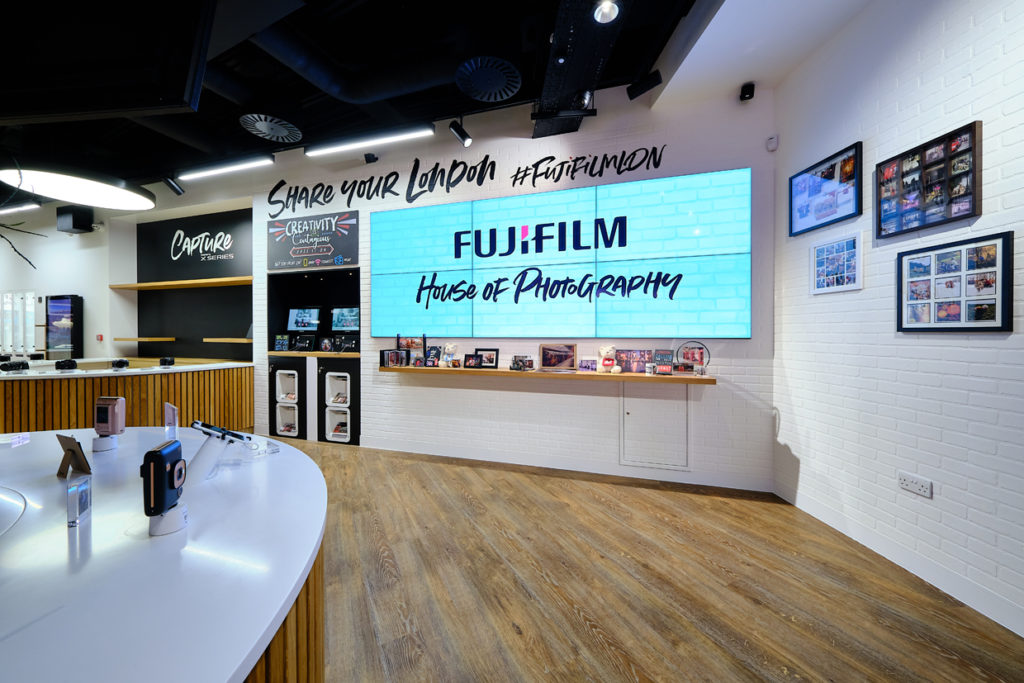
Retail · Experience Centre
Immersive digital signage and a QSC audio system transform Fujifilm's House of Photography in London into a flagship retail experience that engages customers from the moment they walk in.
Read case study →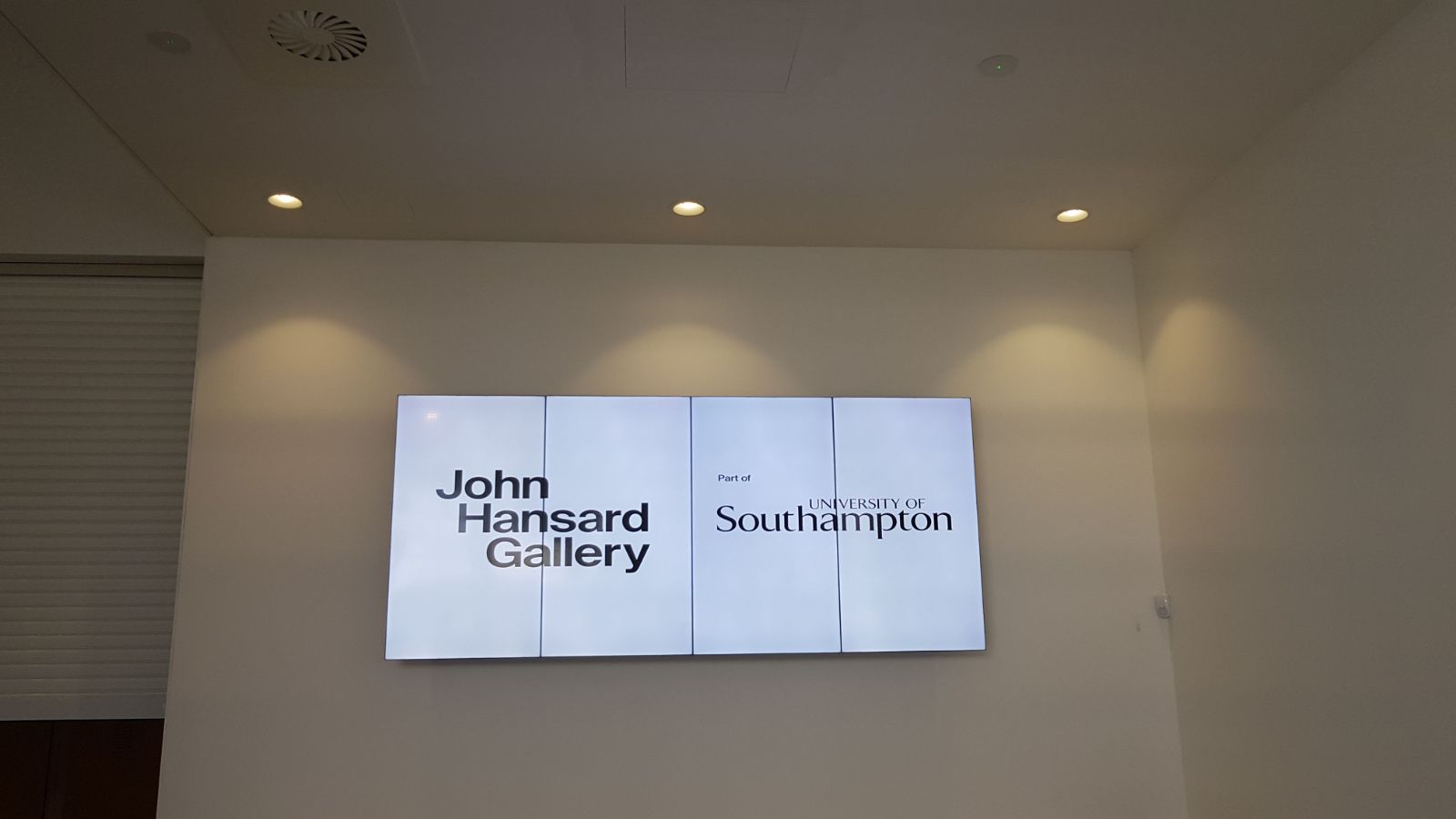
Education · Gallery Videowall
A seamless digital signage videowall for the John Hansard Gallery, installed in just one week to be ready for the gallery's high-profile opening event.
Read case study →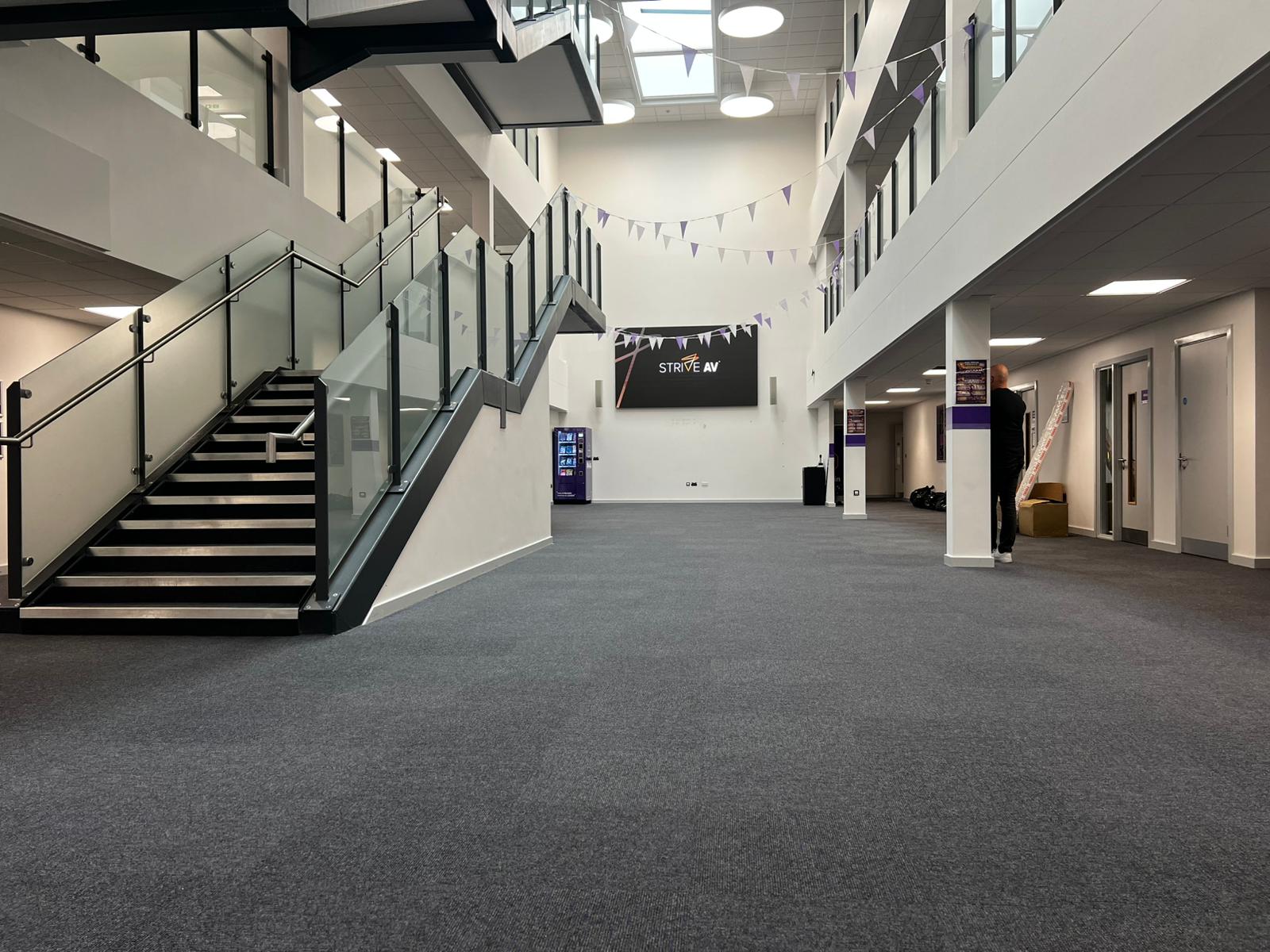
Education · Atrium Signage
A 3.6m wide Hikvision LED video wall driven by CleverLive Pro digital signage software, plus a JBL audio system, turning the academy atrium into a live communications hub.
Read case study →Hardware is only half of a digital signage project; the CMS is what determines whether your team can actually run the network day-to-day. Strive AV is platform-agnostic: we deploy and support a range of digital signage software platforms depending on the size of the estate, the integrations you need, and the security posture you have to meet.
Whether you need a simple single-screen player, a multi-site CMS pulling RSS feeds and live data, or an enterprise platform with role-based access, scheduling and audit trails, we'll recommend, deploy and support the right one for your team. Platform by platform prices and picks are in our vendor-neutral answer to what the best digital signage software is.
Talk to us about your CMS →Time-of-day, dayparting and event-driven content scheduled across single screens or multi-site networks.
RSS, weather, social, room booking, EPOS, dashboards and internal feeds blended with branded media.
Player health, content delivery and screen-on confirmation visible in one dashboard so you spot issues before your audience does.
Site-level permissions and approval workflows for organisations where different teams own different screens.
Hosted in UK or EU regions, with platforms that meet your information security requirements.
Runs on commercial displays, LED video walls and built-in System-on-Chip players, with no vendor lock-in.
Digital signage in the UK typically costs £500 to £4,000 per screen installed, plus £15 to £40 per screen per month for the CMS. The total depends on screen size and brightness, how many sites share one CMS, and how much content you need produced.
| Project | Typical budget |
|---|---|
| Single indoor screen, installed | £500 to £4,000 |
| Small site, 1 to 4 screens | £2,000 to £6,000 |
| Reception or wayfinding, multi-screen | £5,000 to £15,000 |
| Multi-site rollout, 20+ locations (1 to 2 screens per site) | £2,500 to £4,000 per site |
| Outdoor, sun-readable screen | £4,000 to £15,000 per screen |
| dvLED video wall or large retail estate | £20,000 to £150,000+ |
| Component | Typical range |
|---|---|
| Commercial display (32" to 75") | £400 to £2,500 |
| Media player (£0 with built-in SoC) | £0 to £400 |
| Installation and cabling | £150 to £600 |
| CMS subscription | £15 to £40 a month |
| Content production (per network) | £200 to £800 a month |
Real products and prices from TopAV, our sister company, last updated 23 October 2026.
| Kit | Hardware | Hardware, ex VAT | Installed guide |
|---|---|---|---|
| Single reception screenBuilt-in media player, no separate box needed |
| £856 | £1,006 to £1,456 |
| 3-screen menu boardBuilt-in players, scheduled from one CMS |
| £1,407 | £1,857 to £3,207 |
| Premium lobby screen24/7-rated panel with a dedicated 4K player |
| £1,599 | £1,749 to £2,199 |
| 2×2 video wallPlus video wall mounts, priced at survey |
| £6,100 | £6,700 to £8,500 |
| Outdoor screenPlus an outdoor-rated mount, priced at survey |
| £3,664 | £3,814 to £4,264 |
Hardware only, ex VAT. The installed guide adds installation and cabling at £150 to £600 per screen; the CMS (£15 to £40 per screen per month), content and support are extra. Hardware prices move, so your site survey quote is the fixed price.
Quick reference: indoor screens £500-£4,000 each + £15-£40/screen/month CMS; chain rollouts £2.5k-£4k per site; outdoor £4k-£15k per screen. The full breakdown is in how much digital signage costs in the UK; installation labour on its own is £150 to £600 per screen, itemised on the digital signage installation page.
A rough range in seconds. A free site survey turns it into a fixed price.
4 screens, installed
£2,200 to £14,000
plus £60 to £160 a month for the CMS
Excludes content production (typically £200 to £800 a month per network) and support contracts.
Platinum partner status with the manufacturers below gives us direct trade pricing and manufacturer-backed technical support on every project.





Managed digital signage means someone other than your marketing team notices when a screen goes dark. A support contract covers remote monitoring with screen-on confirmation, player and CMS updates, licence renewals, warranty claims and an engineer on site when remote fixes fail. Typical UK pricing is £5 to £15 per screen per month for monitoring and helpdesk, rising to £20 to £40 per screen per month when content scheduling and on-site response are included.
| Service level | Remote response | On-site response | Suits |
|---|---|---|---|
| Monitor and fix | 4 hours, business hours | Next business day | Offices, schools, single sites |
| Managed network | 4 hours, business hours | Next business day, spares held | Multi-site retail and hospitality |
| Critical | 1 hour, 24/7 | 4 hours | Healthcare wayfinding, transport, control rooms |
Contracts sit under our AV support and maintenance service, and the whole network (screens, players, CMS and support) can be taken as a single monthly fee through AV as a Service.
Digital signage companies range from screen resellers to full AV integrators. Whichever you shortlist, hold them to these standards:
More detail in our guide to choosing a digital signage company in the UK, or see our accreditations.
In-depth UK guides on choosing, deploying and managing digital signage, from menu boards to outdoor installations and sector-specific deployments.
A complete UK guide to digital signage in 2026: solutions, software, costs, and use cases across retail, hospitality, healthcare and more.
Read complete guideHardware, software, design, costs, and installation for restaurants and quick-service venues.
Read guideIP ratings, brightness, weather-proofing, use cases, costs and installation considerations.
Read guideStorefront, in-store, point-of-sale, queue management, and content strategy for UK retailers.
Read guideFeatures, cloud vs on-prem, sector considerations, costs, and a vendor-neutral selection framework.
Read guideWayfinding, patient communications, infection control, accessibility, and NHS procurement.
Read guideLobby welcome, wayfinding, meeting boards, F&B menus and brand management across hotel groups.
Read guidePricing models, supplier types, questions to ask, and a practical buyer's checklist.
Read guideA typical commercial digital signage screen in the UK costs £500 to £4,000 fully installed for a single display, depending on size. That includes a Samsung, LG or Sharp/NEC commercial-grade panel, wall mount, basic cabling, a media player or System-on-Chip licence, and a CMS subscription for the first year. Larger screens (75-inch and 86-inch) push the per-screen price to £3,500 to £6,500. Multi-screen rollouts bring the cost per screen down sharply because design, network setup and CMS configuration are amortised across the estate.
We are vendor-agnostic and supply commercial-grade displays from Samsung (QM, QH and OH outdoor series), LG (UH7 and UM3 ranges including window-facing high-bright), Sharp/NEC (M and ME series for 24/7 use), Philips and Sony Bravia Professional. Consumer TVs are not designed for digital signage duty cycles, so we always specify true commercial panels rated for 16-hour or 24/7 operation with built-in System-on-Chip players where it makes sense. The right brand depends on size, brightness (in nits), warranty length and whether the screen is portrait, landscape or window-facing.
We deploy and support the leading UK and global digital signage CMS platforms including BrightSign, ScreenCloud, Yodeck, Samsung MagicInfo, LG SuperSign, NoviSign and Cleverlive Pro for our LED installations. Smaller estates often work brilliantly on Yodeck or ScreenCloud for ease of use and predictable per-screen pricing. Larger or compliance-sensitive networks (NHS, financial services, multi-site retail) typically benefit from BrightSign or Samsung MagicInfo for their enterprise role-based access, on-prem hosting options and audit trails. We help you pick rather than push you toward one platform.
Each digital signage screen needs power and a way to receive content, usually a wired ethernet connection or a managed Wi-Fi SSID. For multi-site rollouts we recommend a dedicated VLAN with outbound internet access to the CMS provider, no inbound ports, and bandwidth of around 5 to 10 Mbps per site for ongoing content sync. We work with your IT team on firewall rules, certificate handling and SSO integration. Where ethernet runs aren't available we can use 4G/5G routers with managed SIMs as a primary or backup connection.
Yes. Hardware is only half the project; content is what determines whether the screens actually drive results. We provide branded template design, motion graphics, scheduled campaign content and ongoing playlist management. Most clients launch with a content design package covering 6 to 10 templates, then move to a monthly retainer for seasonal updates, new product campaigns and live data feed integrations. We can also train your internal marketing or communications team to run the CMS in-house if you prefer to keep content creation on your side.
Modern digital signage platforms can integrate optional anonymous audience analytics using on-screen sensors or AI cameras to estimate dwell time, attention rate, age range and gender, without storing any personally identifiable information. Tools like Quividi or built-in BrightSight features sit on top of the player. This is mostly used in retail and out-of-home advertising contexts where you need to prove campaign reach. We help you implement it in a GDPR-compliant way with clear signage informing visitors that anonymous measurement is taking place.
A single-site digital signage install with one to four screens is typically completed in one to two days, including wall mounting, cabling, player configuration, CMS onboarding and basic content load. A multi-site rollout of 20 to 100 screens is usually scheduled over 4 to 8 weeks, with sites grouped by region and installed in waves to minimise disruption. We pre-stage all hardware in our warehouse (players imaged, screens bench-tested and CMS profiles loaded) so on-site time is kept to a minimum. Installation itself is covered on our digital signage installation page.
Yes. We offer tiered annual support contracts covering hardware warranty management, CMS licence renewal, remote monitoring with screen-on confirmation, content scheduling support and on-site response across the UK. Typical SLAs are 4-hour remote response, next-business-day or 4-hour on-site visits, and proactive alerts when a player goes offline so issues are caught before your audience notices. Support is usually priced per screen per month, with discounts for multi-site networks and committed terms.
Detailed answers to the most-searched digital signage questions, each authored and reviewed by a Strive AV director.
Wayfinding digital signage shows interactive maps, directories and turn-by-turn directions on screens, typically 32 to 55 inch portrait kiosks, used in hospitals, large offices, university campuses, shopping centres and transport hubs. It replaces static printed maps and lets visitors filter by department, floor, accessibility route or open-now status.
A commercial display is a large-format screen from Samsung, LG, Philips, NEC or Sony built for 16/7 or 24/7 operation; a consumer TV is built for six to eight hours of evening viewing. Put a TV in a business and you will typically see burn-in or capacitor failure within 12 to 18 months, and a warranty that is voided the moment it is switched on commercially.
Office digital signage is a network of commercial-grade screens showing internal communications, room availability, wayfinding, visitor information, KPIs and emergency notices. Unlike retail signage, the audience is staff and visitors, and the content skews to operational data (room status, hot-desk maps, fire muster information) over promotion.
Samsung MagicInfo is the content management system for Samsung commercial displays, used to schedule, distribute and monitor content across one screen or thousands. It runs on the built-in System on Chip in Samsung commercial panels, removing the need for a separate media player like a BrightSign or small PC.
Retail digital signage is a networked system of commercial-grade displays used by shops, restaurants, fuel stations and shopping centres for promotions, wayfinding, menu boards and queue information. Unlike consumer TVs, the screens are built for 16/7 or 24/7 operation, support remote content management and integrate with point-of-sale, stock and analytics systems.













Speak to our design team today to discuss your next AV project. We'll guide you through every step - from consultation to completion.
Our industry certifications and accreditations